

This post launches a series. Each Way of Not Working gets three companion pieces — a practitioner how-to on the Personal Kanban blog, a team application at Modus Institute, and a leadership essay at Modus Cooperandi. The first set is live now. (For workshops and to see us in person see our calendar of events).
The Nature of Your Overload Told Through Lack of Overload
My dad was a developer in Grand Island, Nebraska. He’d wake up in the morning, go out and check how the houses were being built, come home for lunch, check again in the afternoon — and then he was done. He’d watch baseball. He’d go fishing. There was genuinely nothing left to do that day.
That is a condition of work that no longer exists for most of us. The internet expanded the universe of things we could be doing beyond any natural stopping point. The internet gave us an infinite amount of things to do. AI has made it worse. We now live in a world of unprecedented options for how to spend the next hour, with no built-in signal for what matters most. AI has given us*** infinite things to do simultaneously***.
Personal Kanban helps me every day. I end up in these states where there’s so much I could be doing, I confuse it with what I should be doing right now. Part of this is priority, but a bigger part of it is that the world conspires against your (my) ability to focus.
So, there’s this specific feeling you get when you sit down to work and immediately feel like you’re already behind. Potential work isn’t a single thing. It’s a cluster. The list is too long. You don’t know what’s most important. Something is stuck and you don’t know why. You’re doing things but nothing feels finished. And somewhere under all of it is the quiet suspicion that you’re not doing the right things at all...that the most important thing, whatever that is, is being crowded out by everything else.
And someone, somewhere ... is yelling.
I know this feeling because I’ve had it for nearly sixty years of being alive. And while building Personal Kanban, teaching it, and watching teams everywhere struggle with the same problems I see it in others. And I see them react to it by blaming, by yelling, or by shutting down.
The feeling... of being behind .... is information. The feeling of frustration (which to be honest I’m feeling as I type this and multiple, equal priorities are pulling at me). The image here shows that at the end of last week I got stuck with these things to do and they are still there. So ... I pulled out the modus kanban/pomorodo and just focused on getting the ends of my book editing done. I focused on that and finished because the new post, modus store, and taxes were simply too much to do at once.
Form follows function and function changes.
Personal Kanban has exactly two rules. Visualize your work. Limit your work in progress. Everything else — every column configuration, every sticky note color, every digital board or hand-drawn circle with work spiraling toward the center — is just an expression of those two rules. The form doesn’t matter. What matters is what happens when the brain can finally see what it’s carrying.
Ways of Not-Working
When we allow ourselves to give in to Reactivity, Overload, and Toxicity. Yes, you, guessed it ROT. You’ve heard of FUD? Well, meet ROT. ROT contributes to us being crazy ineffective while seeming to be productive. It is not a way of working, it is a way of not-working.
Below , I’m listing five Ways of Not-Working ... states in which we regularly find ourselves unable to truly progress while we fool ourselves into thinking we are productive. They aren’t the only five.
Way of Not-Working One: Decision Paralysis
Every Monday, heck every day, I’m Spongebob, jumping out of bed, yelling “I’m ready!” and then running face first into reality. There’s a full day in front of me. Nothing is missing — no information gap, no waiting on someone else, no real reason I can’t work. And I get to the desk and cannot for the life of me figure out what to start. (Well, not every Monday, but ... )
So I open email and check the calendar to make sure no one booked a surprise meeting overnight. I make another cup of coffee and look at the list again, as if it might have rearranged itself into an obvious order. (The email check and the calendar check aren’t necessarily avoidance...they’re grounding rituals, and reasonable ones. But they can’t substitute for a system, and when the ritual ends, the pile is still there.)
It hasn’t rearranged itself.
What makes this particularly hard is the scale of the pile. As I write this, my real list includes: a Modus Institute website relaunch, a rebuilt business model, new consulting clients to find, a book on toxic waste to finish, a novel in progress, and a Modus store to launch. That’s a lot for a company of two people. Any one of those things is genuinely important. The problem isn’t that any of them is wrong to work on. The problem is that a flat list of all of them gives the brain no signal about what to do now.
What’s happening here has nothing to do with laziness or poor character (I hope!). It’s a cognitive cost problem from ROT. When the number of options on a flat list exceeds the brain’s comfortable evaluation range, the brain doesn’t make a bad choice...it stalls and waits for a better signal. And if there’s no signal, it goes either where there’s no cost (Inbox, whoever is yelling the loudest, thing I like doing) or it goes everywhere (starting all the tasks at once).
The last one is a thing. Paralysis is a Paralysis of Decision...not a state of inaction. Doing everything at once is not a decision.
Decision paralysis is not solved by willpower. It’s solved by reducing the number of options the brain has to evaluate before it can act.
Only two rules, WIP limits aren’t a productivity trick. They are a cognitive mercy. When I have a few things in Doing and I’m not allowed to add a new one until something finishes. This helps me not seize up. There are no twenty options to weigh. There are three things in motion and the question is which one to finish next. That question has an answer. The board gives you the answer every time you look at it.
There are so many design patterns here. The easy one from the other week is the Priority Filter which is a backlog with three tiers (P1 for things you think are super important, P2 for important, P3 for everything else). Each tier is WIP limited to ensure you’re always reading the board rather than re-deliberating it. You can always pull from any tier, but you’ll always see the organization and decide, in real time, on execution.
Way of Not-Working Two: Productivity Guilt
This one is quieter and harder to talk about.
Productivity Guilt is where you’ve done a lot today during the day. You can point to real things that got done. But at the end of the day, the feeling is not satisfaction. It’s this low-level gnaw...a sense that the things you finished were not the things that you valued...that you committed to yourself you’d do in the morning. So, you did a lot of things (good things) but in the end they weren’t what you’d set out to do.
We first wrote about this in Personal Kanban...this has been part of the system from day one. Even after all these years, I’m still not sure people recognize it as a system problem rather than a personal one. They experience it as something about themselves. “I’m not productive enough, not focused enough, not disciplined enough.” It is so hard not to internalize what you see as failure.
But this feeling is almost always a feedback problem. We aren’t letting ourselves know what we want to do now... and then give ourselves permission not to do it.
There are two sides to this.
The first is the visibility problem, not seeing the work means we live in our heads (which is where our fears run amok). When you can see what you actually did, the guilt often eases. The second side is harder. Sometimes the day genuinely goes sideways — a piece of technology that worked fine every day for two years simply stops cooperating and there goes the afternoon. A conversation that was supposed to take fifteen minutes becomes two hours, something outside your control lands in your lap.
These disruptions are, in a real sense, predictably painful. They happen to everyone regularly. The question is whether you’re building a system that can account for them, or one that pretends every day will go as planned.
A Done column handles both sides. It is not a place for graveyard items. It is where evidence lives — the real, visible record that your effort produced results, including evidence of what actually happened on the days that went sideways. Review it on Friday morning for five minutes. Not to judge the week, but to see it clearly. People talk about compound interest in finance. The Done column is compound motivation — the accumulating proof that you’ve been working all along, even on the weeks that felt like nothing.
Tonianne and I built Personal Kanban partly because we noticed that the people around us were working themselves into the ground and feeling like they had nothing to show for it. The answer wasn’t to work harder. It was to make what they were actually accomplishing visible to themselves. Once they could see it, the guilt eased. Not because they worked more — because they could finally see that they’d been working all along.
Productivity guilt is not solved by doing more. It’s solved by making what you’ve done visible. The companion move is the Today column — a deliberate pull at the start of the day that makes your intentions as visible as your results.
Way of Not-Working Three: The Overwhelm Spiral
The overwhelm spiral is Overload (the O in ROT) in its purest form. It’s not that you have too much work. It’s that you have too much in-progress work. Everything has been started. Nothing is finishing. Every day you begin with the accumulated weight of everything already in motion, and every day you add more to it without closing anything out.
You feel perpetually behind because you are. Not behind on starting things...you’ve started them all. Behind on finishing them.
I want to be honest about this one, because knowing the mechanism doesn’t make you immune to it. About an hour before I sat down to write this essay, I was bouncing randomly between four live projects...pure context-switching, getting nothing meaningful done on any of them, just accumulating the anxiety of all of them simultaneously. I write about this. I teach it. I still fell into it. What got me out was the Pomodoro: a timer on screen that says, for the next twenty-five minutes, you are working on this thing. Not because timers are clever. Because they’re physical. The screen shows you what you’re doing. You can’t pretend otherwise.
(I also ended up putting this on ice for three days to focus on something else then (now) coming back to it when I can focus.)
This is one of the most common conditions we see when working with clients, and it is almost entirely invisible to the people inside it. They think they’re managing their work. They are, in fact, managing their commitments to start work while systematically avoiding finishing it.
One design pattern that cuts through that invisibility: pattern matching — color-coding cards by project or task type so the board can actually show you what’s in flight. When every card looks the same, the overload is invisible. When they don’t, you see it immediately: seven things in Doing, four different projects, three cards that haven’t moved in two weeks. The board stops being a list. It becomes a diagnosis.
WIP limits break this pattern not because they’re clever but because they’re physical. When the Doing column has space for three cards and there are already three there, you cannot start something new without a deliberate violation. The board stops you not through discipline but through design. You see the full column. You know you can’t add. So you finish instead.
The overwhelm spiral doesn’t resolve through better time management. It resolves when finishing becomes structurally easier than starting.
Way of Not-Working Four: The Stuck Loop
The Stuck Loop is when you have a something in your Doing column for six days. Eleven days. Three weeks. It’s there forever.
It’s still there. It hasn’t moved. You move around it, doing other things, occasionally glancing at it with a feeling somewhere between guilt and dread. It occupies mental bandwidth even on the days you never touch it...which is most days.
It creates existential overhead. Which is where ROT’s Toxicity does its most insidious work. Here’s what makes stuck work different from just delayed work: the longer it sits, the harder it becomes to touch because you become more and more upset about not doing it.
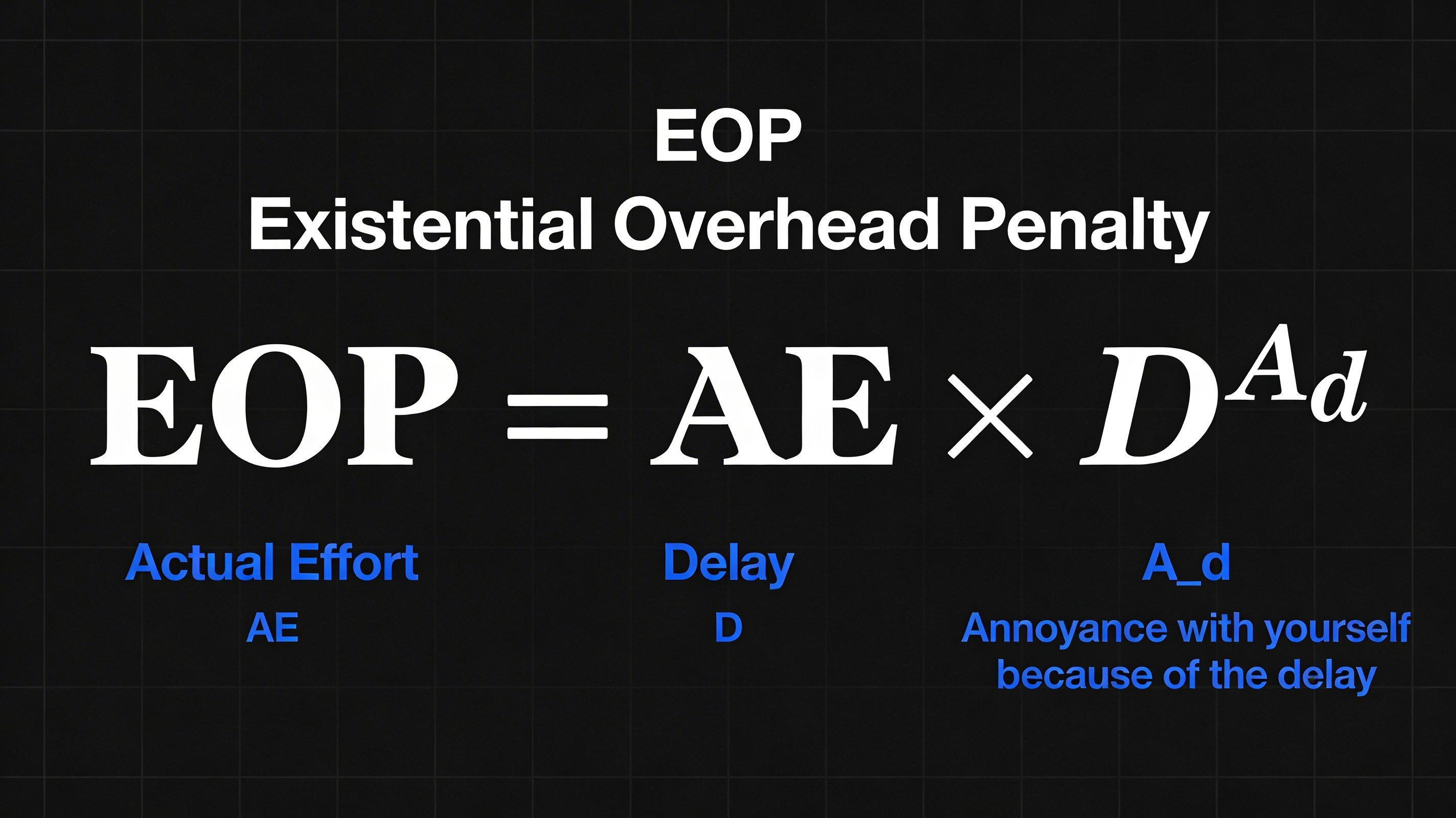
This places a hurdle in your path that gets higher and higher each day. The cost of doing the ticket is now Actual Effort * Delay * Annoyance with yourself because of the delay. This is the Existential Overhead Penalty.
Not because the task itself has grown, but because the guilt compounds. Mine right now are a Shopify shopping cart and taxes. Neither is complicated. Both are boring and outside my natural wheelhouse. And every day I don’t do them, the barrier gets a little higher. You reach for it, and immediately the internal loop starts: I should have had this done a week ago. Why didn’t I have this done? What is wrong with me? And then you don’t touch it again.
That’s the meta-cost. The task itself has a concrete cost (unfinished). But the meta-cost is higher: the cognitive weight of a task that stays in Doing spreads. It becomes a persistent tax on your attention every time you look at the board and see it there. And it gets worse each time.
A gentle reminder for making stuck work visible as stuck rather than just as “in progress.” are aging cards, or cards that get flagged when they’ve been in Doing too long, stuck work announces itself. You can see it.
And seeing it is the beginning of resolving it.
Way of Not-Working Five: Invisible Workload
This one is the hardest to describe because its defining characteristic is that you can’t see it. It is ROT operating simultaneously on all three cylinders. The Reactivity of constant interruptions, the Overload nobody can measure, and the Toxicity of resentment that builds when no one acknowledges what you’re actually carrying.
You are doing more work than your commitments suggest. It’s what we call hidden WIP. Sometimes ambiguous WIP, sometimes guerilla WIP...the commitments you’re keeping that neither you nor anyone else has explicitly named as work. It’s the coordination overhead: the five-minute check-in that becomes thirty, the email that requires three back-and-forth exchanges, the context-switching cost of being the person everyone comes to with questions. It’s the work that keeps the other work moving but never shows up anywhere as work.
Something worth naming here: when you send someone a question, you are creating work for them. A simple question might seem like nothing on your end. On their end it might require an hour of context-gathering and careful reply. I’ve learned to front-load what kind of response I need — “I need a yes or no, don’t embellish” or “Don’t spend a lot of time on this.” This is not rudeness. It’s recognizing that you’re spending someone else’s bandwidth and giving them permission to spend less of it.
The reverse matters too. When someone promised you something and hasn’t delivered — they probably haven’t forgotten. They started, got distracted, couldn’t get back, and now feel guilty about it in exactly the way we’ve been describing. It’s okay to remind them. It’s a two-way street. Treating dropped commitments as character failures, in either direction, misses the actual mechanism: invisible work has displaced visible commitments, and nobody can see the displacement.
Why These Five Ways of Not-Working
After nearly twenty years of teaching this and watching people do it badly and then do it well, I’ve come to believe that most productivity problems reduce to one of these five Ways of Not-Working. And each one has the same underlying structure: something that should be visible is not, and the brain is working too hard to compensate for what it can’t see. Each one is ROT — Reactivity, Overload, or Toxicity — operating in a slightly different form.
These five are not a definitive list. There are dozens of Ways of Not-Working where a board helps — maybe hundreds. But these are the killers. The ones that show up in every kind of work, in every kind of team, year after year.
The board is not a productivity hack. It is an external cognitive system — a place where work can be visible, tracked, and ordered without requiring your brain to hold it all at once.
The brain is not a good task manager. It’s a bad one, actually — full of biases toward the recent, the urgent, and the familiar. Psychologists call one version of this the availability heuristic: whatever you encountered most recently feels like the most important thing, while the thing you’ve been avoiding feels like it somehow doesn’t count. The brain is optimistic by design and poor at accounting. We take on work and overpromise on what we can deliver because we genuinely believe we can get everything done. We almost never can. And the things we promised disappear from awareness while the new shiny thing takes their place.
What the board does is hold what the brain can’t. It makes permanent what the brain keeps misplacing. It records what the brain would rather not look at directly.
The five Ways of Not-Working in this essay — Decision Paralysis, Productivity Guilt, Overwhelm Spiral, Stuck Loop, and Invisible Workload — are the moments your brain is working hardest to manage what it was never designed to manage. They’re also the moments when glancing at a well-designed board provides the most immediate relief.
Not because the board magically solves the work. But because it makes the problem visible. And visible problems are solvable ones.
The Decision Paralysis set is live now:
You Have Everything You Need to Start. So Why Can’t You? — board design for individuals on the Personal Kanban blog
When Your Team Can’t Decide What to Work On Next — team applications at Modus Institute
The Decision Tax Your Team Pays Every Day — leadership perspective at Modus Cooperandi
The remaining four Ways of Not-Working — Productivity Guilt, Overwhelm Spiral, Stuck Loop, and Invisible Workload — will publish over the next two weeks.
Personal Kanban: Mapping Work | Navigating Life is the book that started the movement. If you found this useful, that’s where to go next.
For courses, workshops, and live events, check the Modus calendar or visit Modus Institute.


