

Modus Institute | Personal Kanban | Upcoming Events
In an information landscape, there is helpful and toxic information. We don’t get to just ignore our landscape, though. In our Humane Work Subscribers Lean Coffee today, where we talk about how we get our work done, one of the tickets was about how to use LinkedIn.
There is a very predictable devolution of social media sites. Twitter went down first, then Facebook, and now LinkedIn…when the amount of toxic information outweighs the useful or supportive. On LinkedIn there are two rules: don’t post about politics and don’t post AI shlock. And…it’s 75% politics and AI shlock.
So, you open LinkedIn with a specific purpose in mind. Job hunting, community participation, announcing something and you say to yourself: “Just five minutes.”
Forty minutes later, you’re three layers deep into an argument about whether Agile is dead (again), you’ve scrolled past seventeen AI-generated listicles about leadership lessons with enough emojis that by the end you are certain you are going to the prom with this person, and are cognitively and emotionally overwhelmed from consuming information that looks professional but has zero soul.
You close the window. You think you are done, but you are contaminated.
For the next two hours, you’re more irritable, less focused, more cynical about your field. You are annoyed that you wasted forty minutes, but you’ve also really messed with your focus for the rest of the afternoon.
LinkedIn in 2026. The radiation is real. But the value of the platform is still there. We can, like most toxicities, find a way to eliminate the negative and find some positive to accentuate.
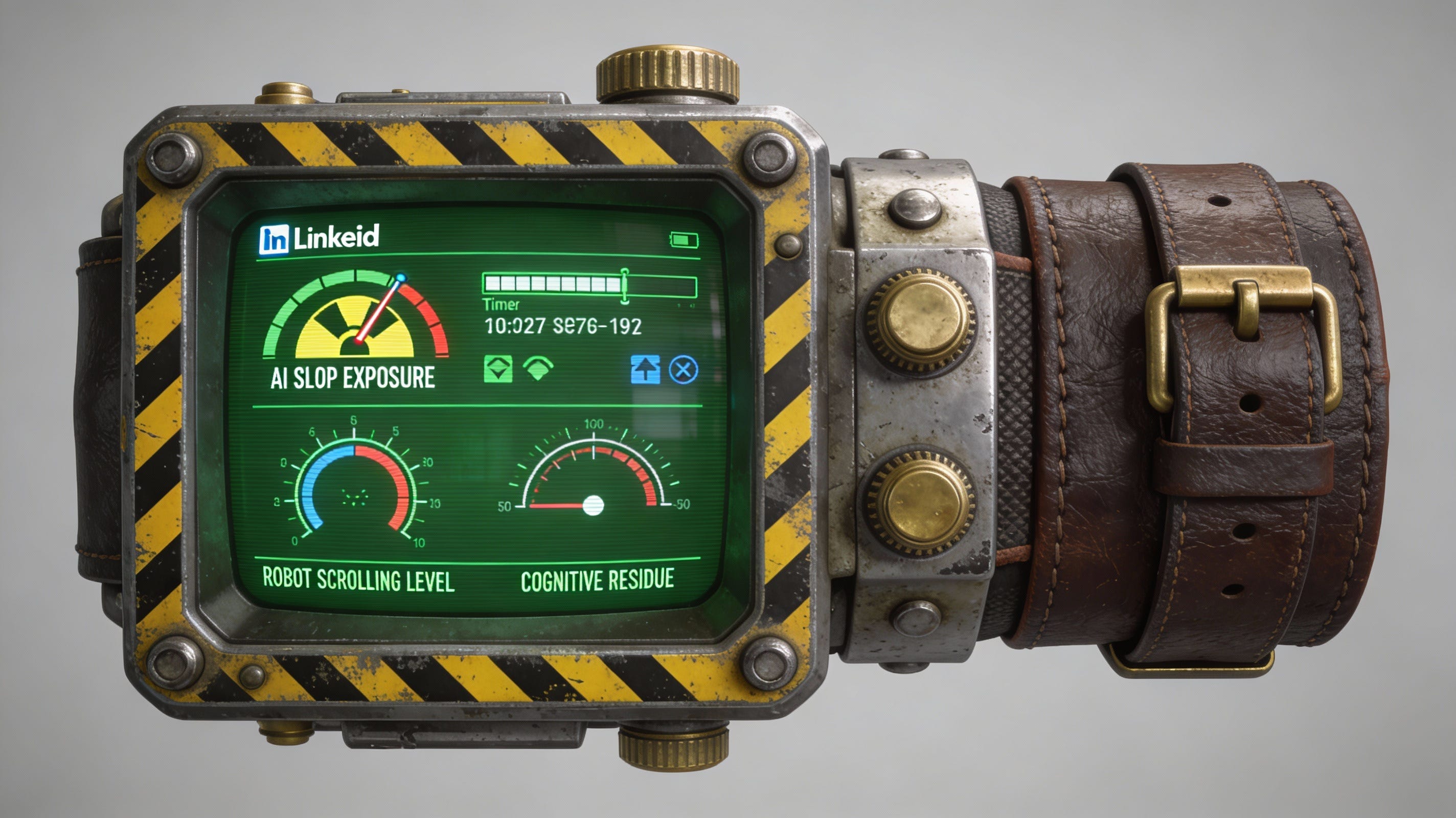
The Fallout 4 Framework or Binging LinkedIn
“Accentuate the positive, e-limmmm-inate the negative.” ~ Bing Crosby
I spent a lot of time playing Fallout Four. As did Andrew Lenards, in the call, but in the game, you run around a post-apocalyptic wasteland filled with radiation. You can’t avoid it entirely…some areas are too valuable to skip, some resources are too important to leave behind, some bad guys are too bad to avoid. But you have a Geiger counter in your Pip boy. You track your exposure. You know your limits. And, you go out geared up, you wear a variety of hazmat suits to protect you in different ways at different times. But you have a key metric you are always watching: you leave before the contamination kills you.
You see where we were going with this…LinkedIn is the same.
For many professionals (looking for work, building networks, or establishing credibility) LinkedIn isn’t optional. It’s where opportunities live.
But it’s also contaminated, diluted, and dangerous.
Not by radiation, but by what we called in the Lean Coffee robot scrolling. The algorithmically-driven consumption of AI-generated or Process-doom content that makes you have to read it to find out if they are even serious. It’s all plausible enough to look like valuable content and then, when you are done, is either 100% confirmation bias or 100% anger inducing. In other words…toxic.
But we need to use LinkedIn so we need to figure out how much exposure can we tolerate before I lose more than we gain?
So, let’s grab some garb and build a hazmat suit.
LinkedIn’s Specific Toxicities
We need to understand the contamination and how it is spread so before we talk about mitigation, let’s diagnose the problem clearly.
Signal-to-Noise Inversion
LinkedIn used to have a decent signal-to-noise ratio. Real professionals sharing real insights, mixed with some self-promotion and the occasional praise for process. Maybe 90% signal and 10% noise.
That ratio has inverted.
We’re now swimming in 90% noise and desperately looking for the other 10%. The problem here, which was the same problem on Facebook is that this is intentional and algorithmically based. It’s actively engineered to look like signal. This means you used to go in and read, now you go in and spend serious energy trying to find the value. You went from berry picking in a fertile field to gold mining with an axe.
Dopamine Exploitation
In the call, Tonianne DeMaria used the phrase cheap dopamine. This is not the beautiful meal dopamine, it’s the McDonald’s burger dopamine. So, your brain on LinkedIn looks like:
Anticipation spike: Your brain gives a small hit of dopamine. “Maybe there’s a good post today. Maybe someone engaged with my content. Maybe there’s an opportunity. Maybe…”
The scroll begins: You encounter the first post. It’s AI slop—”Agile is really really dead: Thrive emdash smiley.” Mildly annoying, but you keep scrolling.
Intermittent reinforcement: Every fifth post, there’s something marginally interesting by someone you actually know. You like it. and…keep you scrolling. This is the most addictive reward schedule known to neuroscience and it is now a business model.
Emotional spikes: You encounter a post claiming “Agile is Dead” (for the 400th time this year). Even though you know it’s engagement bait, you feel a reaction—irritation, defensiveness, the urge to comment.
Compulsion continues: “The next one might be good.” Your prefrontal cortex (the part of your brain responsible for executive function, decision-making, focus) is slowly being bypassed. You’re are now addicted to the dopamine-seeking loop.
Finally you close LinkedIn: You are shocked how long you were there. And your nervous system doesn’t reset. Your focus is fractured. The cognitive residue lingers for hours.
You and your brain are responding to an engineered environment designed to maximize your time in their platform, not your professional growth.

Let’s Build a Social Media Hazmat Suit
We have to use LinkedIn, it’s literally a monopoly on business attention. So, lets build a system that protects us from contamination while still getting value.
Your Helmet of Intention
This is your radiation suit’s Helmet.
Go In With a Goal:
“I need to check messages from recruiters”
“I need to post this article I wrote”
“I need to DM three specific people about collaboration”
Go In With a Time Budget
Not “I’ll just check quickly.” Give yourself an actual number: 10 minutes. 15 minutes max.
Go In Self-Aware
“If I encounter three AI-slop posts in a row, I close the app”
“If I start feeling irritated or cynical, session over”
This pre-load shifts you from reactive (algorithmic drift) to strategic (purposeful use).
Practical implementation: Before opening LinkedIn, take three deep breaths. Literally. It sounds trivial. It’s not. Those breaths ground you, reduce your baseline stress response, and prime your brain for intentional action instead of compulsive scrolling.
Your Time Suck Exposure Meter
In Fallout 4, you track exposure. You need the same for LinkedIn.
Create an actual budget, I’m thinking one 25 minute pomodoro a day:
Weekly exposure limit: Decide how much LinkedIn time you can afford before contamination outweighs value. 1-2 hours per week maximum.
Session length cap: No session should exceed 15-25 minutes. If you go longer, you lose control, the algorithm takes over. Set a timer. Your perception of time distorts on social media by design.
Quality threshold alarms: This is your Geiger counter clicking. Define your personal “radiation alarm”:
Shlock Alarm: Three AI-generated posts in a row = session over
Click Bait Alarm: Two “Agile is Dead” / “Leadership is about super listening” posts = close app
Lost In Space Alarm: Any moment where you catch yourself scrolling without knowing why = immediate exit
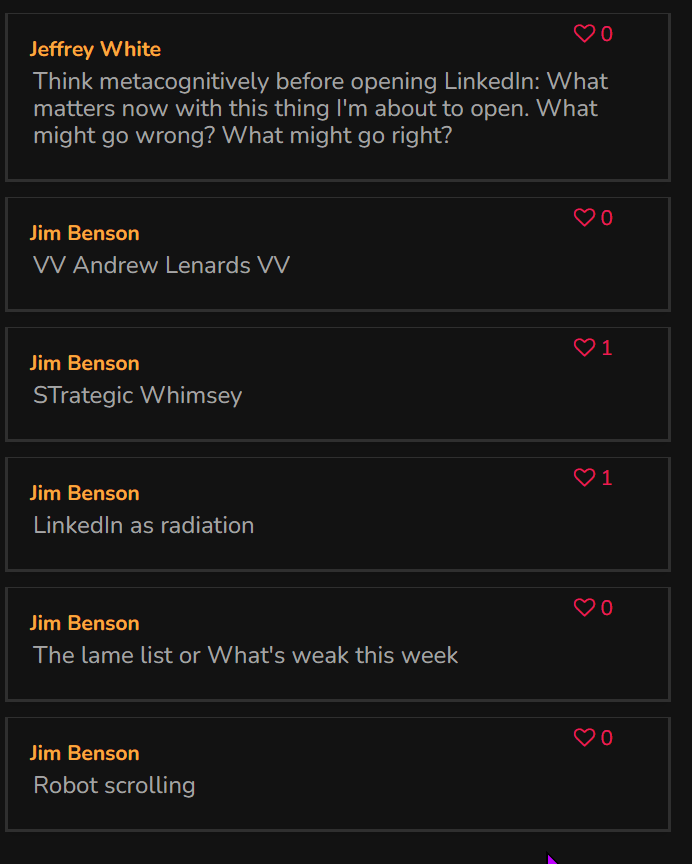
The Respirator of Strategic Whimsy
This phrase came from our Lean Coffee, and I wrote it .
Strategic: You go in with a plan. You know why you’re there, what you need, and when you’re leaving.
Whimsy: You allow for serendipity. If you encounter something genuinely valuable, you engage with it. You’re not so rigid that you miss real connection. Find funny over fury. Look for ways to engage that aren’t doom, rage, or being duped.
You dictate the terms, not LinkedIn’s algorithm.
Decontamination Rituals
You should, after an pomodoro, take a 5 minute walking break. This is especially true for LinkedIn, you need a decontamination ritual.
The cognitive and emotional residue doesn’t disappear when you close the tab. If you go straight from LinkedIn into a meeting or deep work session, you’re bringing the contamination with you.
5-minute decontamination options:
Get up and walk around (physiological reset) ← Best one …
Write one paragraph about something you’re working on (forces your brain into creative mode)
Read one page of a physical book (shifts neural pathways from reaction to comprehension)
Solve a simple problem or puzzle (re-engages executive function)
We Work Better Together—Even Here
The reason we’re having this conversation isn’t because LinkedIn is uniquely toxic all the socials are challenged this way. But we still need community, and we need to figure out how to engage even when most internet traffic is artificial.
Job seekers need visibility. Professionals need networks. Thinkers need audiences. Those are real needs, and LinkedIn still serves some of them.
But we also need spaces where:
Robot scrolling doesn’t replace human curiosity
Performative expertise doesn’t crowd out genuine learning
Algorithms don’t dictate what matters
That’s why we’re here on Substack. That’s why people come to our Lean Coffees. That’s why this conversation is the true final human frontier.
LinkedIn isn’t going away. The radiation will probably get worse before it gets better. But you don’t have to be a passive victim of content quality devolution.
Build your hazmat suit. Track your exposure. Find your decontamination zones.
And when you’re ready for actual human conversation instead of robot scrolling, you know where to find us.
The salesy bit:
The challenges you’re facing…overload, unclear priorities, toxic work patterns…don’t have to be permanent. Modus Institute courses and events help respond practically, with human-centered actions that create clarity, reduce stress, and drive results.
🎓 Explore Our Classes | Personal Kanban | 📅 View Calendar | 📖 Get the Personal Kanban Books | 💬 Book a Consultation
Learn to visualize work, limit WIP, and build humane systems that respect people while delivering exceptional value.


