
Sleeping Soundly on the Wrong Metrics
Are your KPIs lying to you?

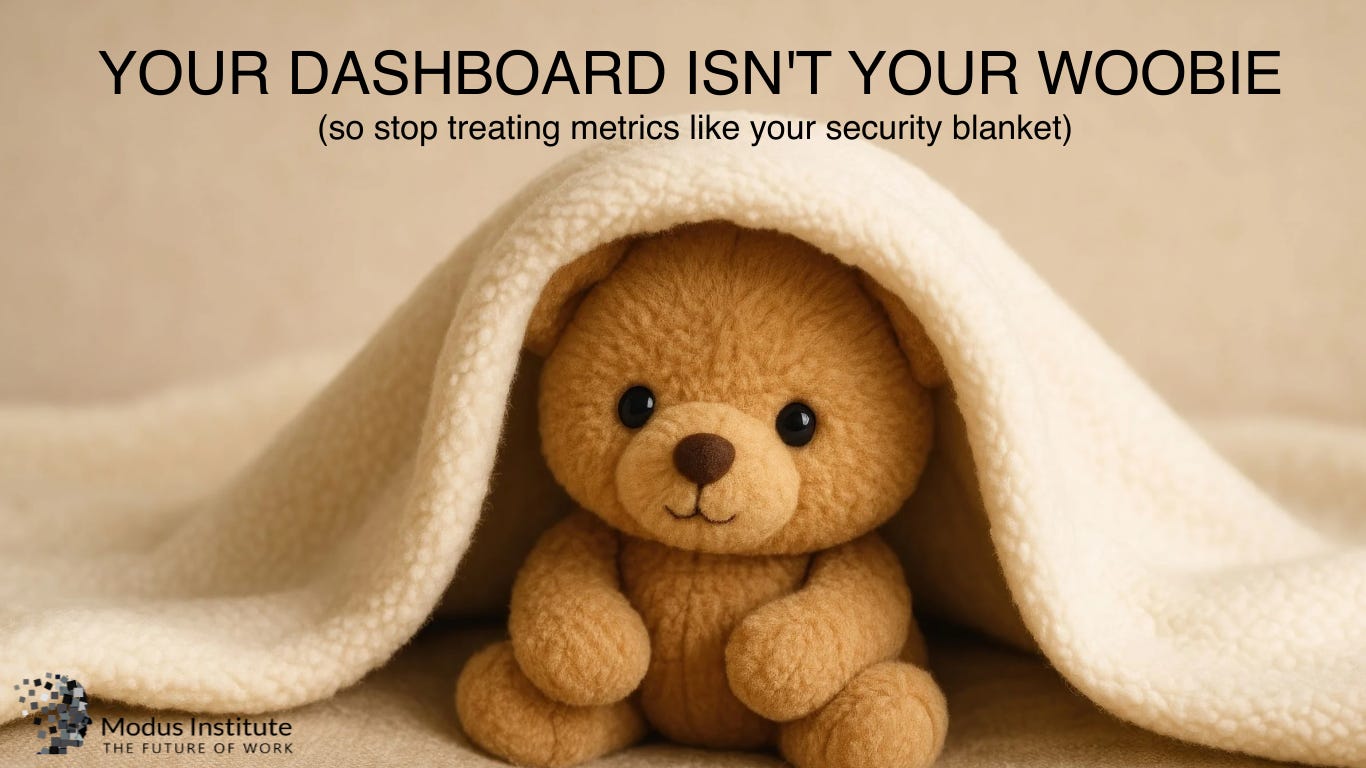
Packing for Camp
When I was little, I had a small well-loved white blanket with frayed satin edges. Every night I’d rub its cool smooth binding between my fingers until I drifted off to sleep.
My mom, ever the practical one, saw it as a crutch.
“You’re stronger than you think,” she told me, as I attempted to justify its place in my already-locked steamer trunk packed for Girl Scout camp. But 8 year-old Toni wasn’t ready to hear it. I was convinced my world would be unsafe without it.
Fast forward to my arrival - solo - at Camp Brady. When “it” happened.
And by “it” I mean…nothing terrible happened. I made friends. I got through homesick nights.
The fear of course wasn’t really about the blanket; it was about not trusting myself without it.
When weeks later my bus arrived back at NYC’s Port Authority, I ran into my parents’ arms excited to show them my 42 chigger bites, the frog I packed in my collapsible cup (sadly, albeit predictably dead), and how I’d outgrown the very thing l was sure I couldn’t live without.
Homesick for Data
In organizations, metrics often play the same role as my security blanket. At first they soothe our anxiety about uncertainty and complexity. Over time though, it becomes less about seeing reality clearly and more about needing the dashboard to proverbially tuck you in before every decision you make.
We’ve all been in meetings with “that” person. The one who can’t make a point - let alone a move - without checking their dashboard. Who needs every decision wrapped in the comfort of a spreadsheet. Who treats their KPIs like a child’s security blanket, unable to face uncertainty without it.
Lost in the Woods
I’ve been that person. Our metrics looked perfect: stellar cycle times, impressive throughput, a Done column packed with completed work. But staring at our Kanban I saw what the numbers were hiding. We were efficiently delivering the wrong things, quietly steering our consulting company into becoming an events-planning business instead. The more comfort I took from the metrics, the less contact I actually had with reality.
That’s when I realized: a metric stops being a tool and starts being a woobie when it hurts more to question it than to be wrong.
You feel social or political risk in asking, “Does this actually match what we see?” and so everyone just clings to the dashboard tighter. It also becomes a woobie when it tells a picture-perfect story your team’s body language betrays, when the numbers show green but in front of the board you see exhaustion, unnecessary churn, or the slow slide into the wrong business altogether.
A woobie metric replaces conversation instead of starting one.
Decisions get defended with, “Because the KPI says so!” instead of “Let’s walk the work…let’s go to the gemba, let’s look at the Obeya, and see what’s really happening.”
Kanban, Lean, and Obeya are disciplines of going to see, of walking the work until what is on the wall, what people say, and what the numbers report all tell a coherent story.
As leaders we do the same thing I tried to do as a kid: lock our woobie in the steamer trunk and argue “It’s essential!” for the trip, for my survival. Only now the woobie is a dashboard. The work is to give ourselves the same gift Camp Brady gave me: a safe-enough place to discover that we can, in fact, make good decisions without clutching the blanket. To return home able to say we’ve outgrown the thing we were sure we couldn’t live without.
Finding Your Way Home
So here’s a small experiment: This week, pick one beloved metric in your Kanban or Obeya and treat it as an hypothesis - not a verdict. Ask If this number is true, what should we see in the room, on the board, and in people’s behavior? Then go and look at it together. If what you see doesn’t match what it says, the work isn’t to cuddle the metric harder; it’s to put the woobie down, feel that moment of vulnerability, and rebuild a shared picture of reality instead.
Trail Markers
If you’re realizing that some of your metrics might be woobies…and that you don’t actually see your work as clearly as you thought, there are two simple next steps.
Register for our Free Webinar: You Have to See it to Manage it December 9th
If your dashboards feel comforting but your days still feel chaotic, join Jim and me for a FREE 1-hour session on why invisible work breaks your capacity, focus, and even leadership - and how to start fixing it with simple visibility practice you can try the same day.
Register for our Workshop: See Your Work-shop: Build Your Personal Visibility System
If you’re ready to go beyond insight and actually build a system, this 2-hour workshop will help you design a Kanban board that fits your real work, your real capacity, and your real boundaries - so you can stop convincing people you’re busy and start managing your commitments with clarity and confidence.
If your metrics are your woobie, these sessions are your Camp Brady: a safe enough place to put the blanket down and learn to trust what you see.
But with no dead frogs this time, I promise.
This reminds me of using established data measures like a map app, but the terrain is much different, let alone its people, their dialects, cuisines, and core cultural values…and on and on.