
Nine Little Birds...
What a weekend of birdwatching taught me about guilt, attention, and letting our nervous system win for once

Just recently, I saw a meme that suggested if you find yourself suddenly into birdwatching, it’s probably time to schedule that colonoscopy.
Fair enough, except I’ve been birdwatching for a few years now. And it’s changed me - noticeably, profoundly. So if this is an age thing, I’ve already got a head start on it.
Rise up this mornin,’ smiled with the risin’ sun…
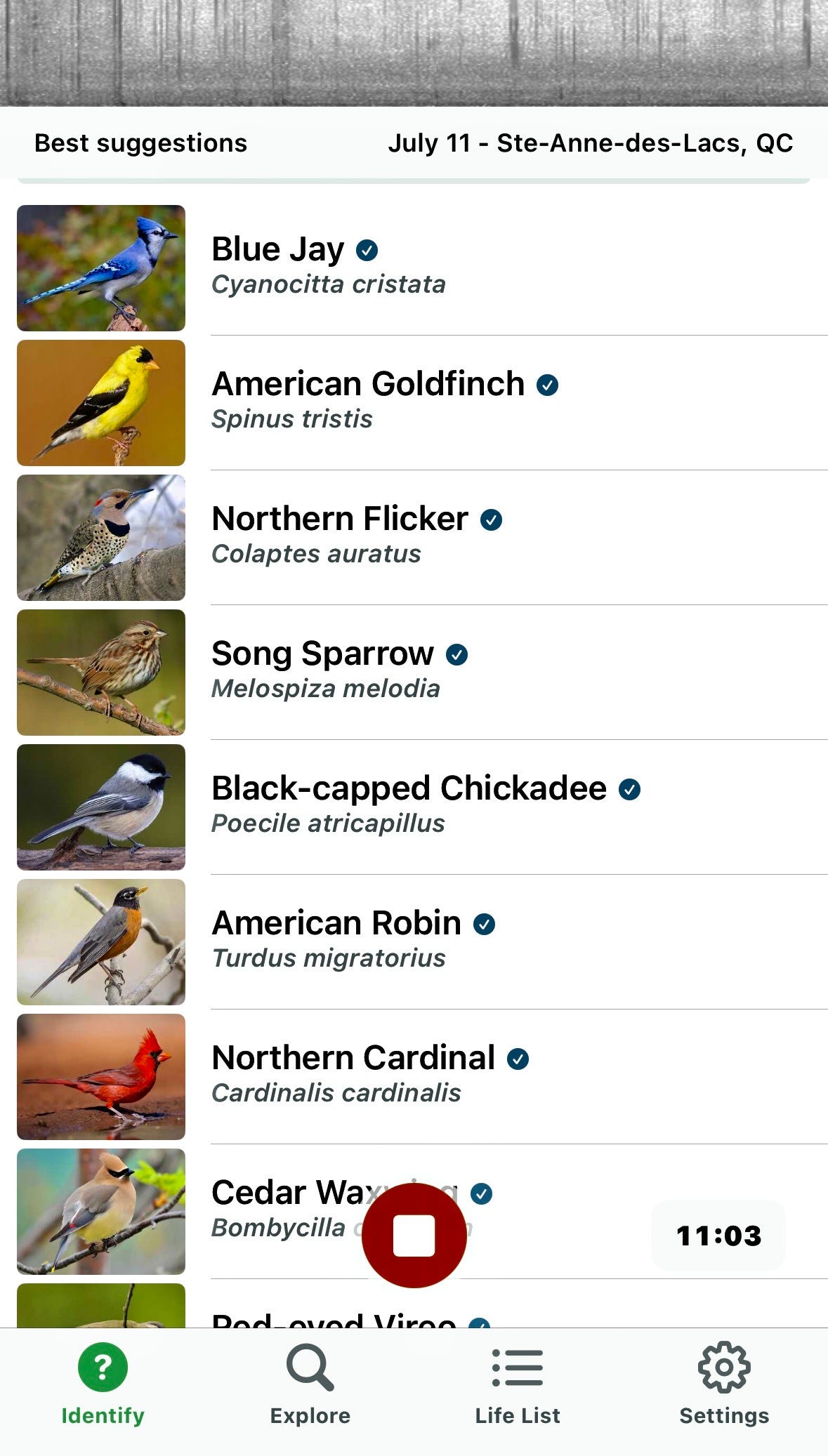
This weekend especially, my Merlin bird app got itself a workout. At one point it logged nine species in just 11 minutes, Blue Jay to Cardinal to Red-eyed Vireo, while I did nothing but sit in my garden, observe the wildlife, listen…and simply be.
I delighted in my marmot, who after chowing down on an errant plum hauled himself out on a rock to take the sun like the otters I loved to watch in Washington’s San Juan Islands (except he looked less aquatic and sleek and more woodland and well, kinda like an overstuffed yam). Then there were my chipmunk buddies leaping through the tall grass on their tiny little legs as if they were dolphins majestically breaching the surface, pausing only to stash peanuts in my lavender beds. A woodpecker couple took turns at the suet feeder, each one waiting patiently off to the side for the other to finish like their mama raised them right. And the most magical hummingbird strafed my cheek en route to its feeder, reminding me that some of life’s most-welcomed interruptions weigh barely four grams.
‘Cause every little thing, gonna be alright.
Truth be told though, I don’t think my foray into birdwatching was age-related. I think it’s simply what happens when your nervous system finally steps in and does for you what you won’t do for yourself, and reminds you what you actually need.
And mine, apparently, had a lot of catching up to do.
Because something shifted in my head this weekend, and I never once opened my laptop. Nothing got crossed off a list or moved on a kanban. And it turns out that was the most productive move I made.
Now the old Toni (not “colonoscopy old,” but the version of me who used to feel guilty about weekends like this) would’ve spent her Sunday night mentally cataloging everything she didn’t accomplish. But new, improved Toni (Now, with 25% more clarity and calm!) felt something different happen instead: her shoulders dropped, her jaw unclenched, her breath slowed, and that nagging internal voice that says “you should be doing something” just…quieted.
She didn’t decide to let this weekend be enough. Her body did.
Singin’ sweet songs of melodies pure and true.
Underneath all of this wasn’t simply the inherent value of taking time for mental breaks, but specifically taking them amid birdsong, the soundtrack my Merlin app had been quietly logging the entire time, even when I wasn’t paying attention. As it turns out, birdsong isn’t background noise, but a signal. Birds don’t sing when a predator is nearby. They go quiet, watchful and waiting. So a landscape filled with birdsong is declaring itself safe, and something deep within us - older even than our language or our work worries - still listens for that. It’s essentially Nature’s green light giving us permission to put down our defenses and simply exhale.
King’s College London backs this up with tens of thousands of real-time check-ins showing that simply hearing or seeing birds lifts your mood for up to 8 hours afterward, even in people managing depression. That’s the surface-level shift. But Kaplan’s Attention Restoration Theory (ART) explains what happens at a deeper level: the deciding, the prioritizing, the everything-is-on-fire kind of attention I burn all week is a muscle, and it got a full weekend off while birdsong gave it something to enjoy and recover from instead of manage.
And here’s the detail that further validated my weekend: a 2026 study found that expert birdwatchers have measurably denser brain tissue in the exact regions that handle attention and perception. This is an actual physical difference being made - not just a skill being sharpened - and it’s linked to better protection against age-related decline.
So the way I see it, that colonoscopy meme had it backwards: noticing birds isn’t a sign your body is falling apart. It’s strength training for the part of you the aging process often takes first.
This is my message to you…
Nine little birds. Zero laptop hours. Turns out my most value-added work this weekend wasn’t on my laptop.
It was on my brain.