
From War Rooms to Obeya
Why Words Matter

Words, Metaphors, and Mindsets
A while back on LinkedIn I posed the question whether the metaphors we casually throw around in business actually serve us. One in particular - the habit of calling collaborative spaces “war rooms” - stuck with me.
Lately I’ve been revisiting that idea, even more convinced that the words we choose shape the work that we do.
Cognitive psychology tells us metaphors are not neutral. And so when we frame collaboration in the language of combat, we prime people to approach it with the mindset of combat.
And then it feels like combat.
We’ve all been in meetings were there is energy. The energy is urgent, and not in a good way. The walls are papered in printouts confirming a single perspective (power), the problems are always personalized (blame), people are uncomfortable (fear), and the unspoken rules are:
Survive crisis
Figure out the rest later. Or at some point. Whenever. Maybe. Yeah, who we kidding, I’ll be gone by then, or something.
This is precisely why I’ve been drawn to the Obeya approach. It reinforces how collaboration isn’t about winning battles, but about building something together - a product, a service and, above all, a uniquely human experience worth sharing.
What is Obeya?
Japanese for “big room,” Obeya was popularized by Toyota during the development of the Prius, which went to market in record time because engineers and leadership worked side-by-side in a shared space to tackle complex challenges. More than a room filled with charts, Obeya is a leadership system that links strategy to execution in a shared visual space - physical or digital - where teams align, make durable decisions, and continuously improve. As a dynamic collaboration and communication hub, Obeya is supported by a mindset that fosters:
Transparency over silos
Collaboration over conflict
Foresight over firefighting
By making work visible and conversations collective, Obeya helps replace confusion with clarity and build the trust needed for teams and organizations to succeed in complexity and confusion.
Why Language Matters
Words beget behavior. The words we use shape how we work. "War room” suggests crisis, command-and-control, and a fight to survive.
Obeya, in contrast, calls us to transparency, agency, foresight, and shared ownership. An Obeya gives us an infrastructure to building systems that can rapidly create value, deal with change, and nurture those who engage with those systems to do the same.
Military Language in Business
Military-influenced ideas and verbiage are hardly new to the world of business. They've been borrowed for decades, sometimes because the mindset feels familiar, sometimes because they simply sound powerful.
From an historical perspective, many management theories and practices were developed or influenced by former service members, especially following World War II. A couple of cases in point for my fellow history enthusiasts:
Former Secretary of Defense Robert McNamara became president of both Ford Motor Company and the World Bank, applying statistical control methods he learned in the military to business operations.
Founder of FedEx Fred Smith drew upon his Marine Corps experience to develop their hub-and-spoke logistics systems.
Bill Marriott - while not a veteran himself - credits his father’s service in the Navy for many of the management practices employed in his hotels.
With just a cursory look, it's clear the parallels between the military and business run deep: strategic thinking, competition, hierarchy, leadership, resources allocation.
My own exposure to the military is why we at Modus conclude every client engagement with an After Action Review (AAR). Introduced by the US Army in the 1970s, the AAR is still the best format I’ve found for capturing organizational learnings and action plans for improvement.
So yes - military concepts have their place. But that still begs the question: Are combative terms like “war room” really appropriate for collaborative environments like an Obeya?
The War Room vs. the Obeya
Unlike the confrontational connotation of a war room, Obeya emphasizes collaboration, visual management, and holistic problem-solving.
The intent is not to solve crises in isolation, but to cultivate a proactive, transparent, and continuous improvement culture. While war rooms often respond to urgent needs, an Obeya fosters long-term planning and sustainable progress.
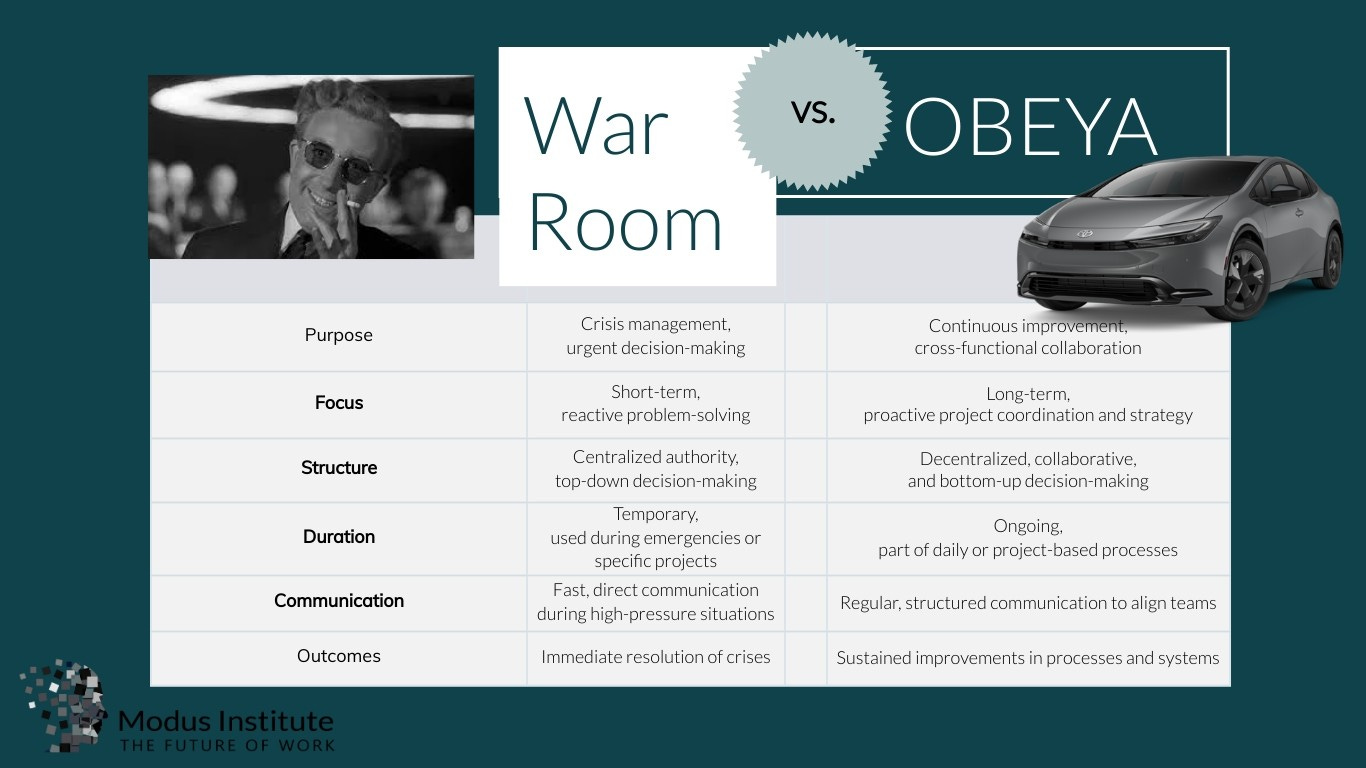
Side-by-side, the difference is clear:
War Room: crisis-driven, immediate, top-down
Obeya: foresight-driven, adaptive, collaborative
A Shift in Mindset
As this comparison reveals, the war room and Obeya are not merely different tools or environments, they reflect fundamentally different mindsets.
The war room, with its crisis-driven, top-down approach is suited for high-stakes, immediate problem-solving. It thrives in situations where urgency outweighs collaboration, and rapid decision-making is critical for success and even survival.
The Obeya embodies a shift in mindset, away from the high-stakes, command-driven approach of the war room and instead towards a culture of agency, adaptability, and shared ownership. In an environment where agility and innovation are key to an organization’s long-term success, the Obeya emphasizes foresight over firefighting, transforming reactive problem-solving into proactive continuous improvement. It encourages collaboration across teams and functions, driving not just quick fixes but sustainable solutions that evolve with the organization.
Because at the end of the day, the goal of the war room is survival: to make it through the crisis at hand. But in an organization that prioritizes thriving over simply surviving, what is required is a system that fosters collaboration, innovation, and continuous growth.
That is the very heart of Obeya.
A Room Built for Tomorrow
The war room is about making it through today. The Obeya is about shaping what comes next - with foresight, alignment, and collaboration at the center.
Where urgency ends, leadership begins. The war room might win you a battle, but sustainable leadership requires a space built for clarity, connection, and long-term growth.
Not survival. Strategy. That's the fundamental shift Obeya offers: from crisis-fueled reaction to intentional, collaborative progress.
At Modus Institute, Jim Benson and I have seen first-hand how difficult it can be for leaders to move beyond this war room mentality. Over the years, helping both co-located and remote teams build their first Obeya rooms has shown me both the challenges and the transformation that's possible. That's why I'm so excited to share a way from more change agents to experience the shift directly.
Stepping Into Obeya
If reading this has you thinking, Yes this is exactly the shift my team needs - but how do we actually make it real? Where do we get started? you're not alone. Many leaders we work with recognize the limits of war room mode, yet struggle to build the kind of shared space where strategy and execution finally meet.
That's why in partnership with our friends at Obeya Association, we're launching the first North American Guided Obeya Fundamentals Certification: a one day, intensive hands-on program that gives you the principles, practices, and rhythms to design an Obeya for your own context.
This training is especially valuable for:
Leaders and Managers who need better visibility into priorities and progress
Agile Coaches, Scrum Masters, and Consultants who want a practical and recognized way to help teams align and focus
Remote or Hybrid Teams who feel scattered and want a shared space for alignment
Operations and Transformation Leaders tasked with bridging strategy and execution
For those in consulting or coaching roles, we offer something rare: a way to walk into client engagement with practices and behaviors that instantly bring clarity, structure, and credibility to the room.
Step Forward
The war room belongs to yesterday: a place of urgency, command, and firefighting.
The Obeya belongs to tomorrow: a space for clarity, collaboration, and strategy.
This guided certification isn't just a class. It's your doorway into a global movement that's reshaping how modern organizations work.
The first cohort of the North American Guided Obeya Fundamental Certification is intentionally small, so every participant has space to learn, practice, and connect. If you're ready to leave firefighting behind and step into a way of working built on clarity, foresight, and collaboration, I'd be honored to have you in this founding cohort.
Whether you come as an individual leader, a consultant guiding clients, or a team seeking a shared way forward, you'll leave with more than a credential, you’ll leave with a way of working that makes clarity and collaboration your team’s default. Work begins to feel clearer, calmer, and more connected.
Less like survival, and more like genuine leadership.
Secure your place in the North American Guided Obeya Fundamentals Certification today.
One more difference between a war room and a visual room (Obeya):
With a war room, you step into it and get out of it. You don't live/work there. Psychologically, it's very different from a place you work and collaborate in *all the time*.
One of my favorite stories on the latter is about a huge project in one of my past companies. We literally tore down two walls to make one collaborative space for everyone. Then, we dedicated one wall to be an overarching visual radiator for all the important stuff that was happening.
The fact that it wasn't a dedicated space to meet but a regular workspace made it even better. Visual signals were there for all to see, all the time. Whenever something was changing, it was within the peripheral vision of most of the team. Ad-hoc swarming was as easy as it gets.
At some point, that space served even as a defense against war-inspired influences coming from outside. As in: "That's how things look. Clearly. It's literally on the wall. I can promise you all the dates you want, but it won't make the work be in a different state than it is."
These days, I rarely, if ever, need such a huge space, so big a team, or that many visualization details. And yet that experience stuck with me. Any time I see a lack of clarity, I would introduce the visual radiators that show an important part of the effort.
It won't be a typical Kanban board, as one rarely needs that much detail. But an epic board (Kanban with epic stories) is one good example. In one recent example, it was an availability board (who works which hours and whether from the office or from home), as we clearly had coordination issues.
It doesn't have to be a fully dedicated space or a complete picture. It's enough to communicate what matters and where it matters.