
From Huddled to Free: Making Invisible Work Visible
Three Statues, One Question About Work

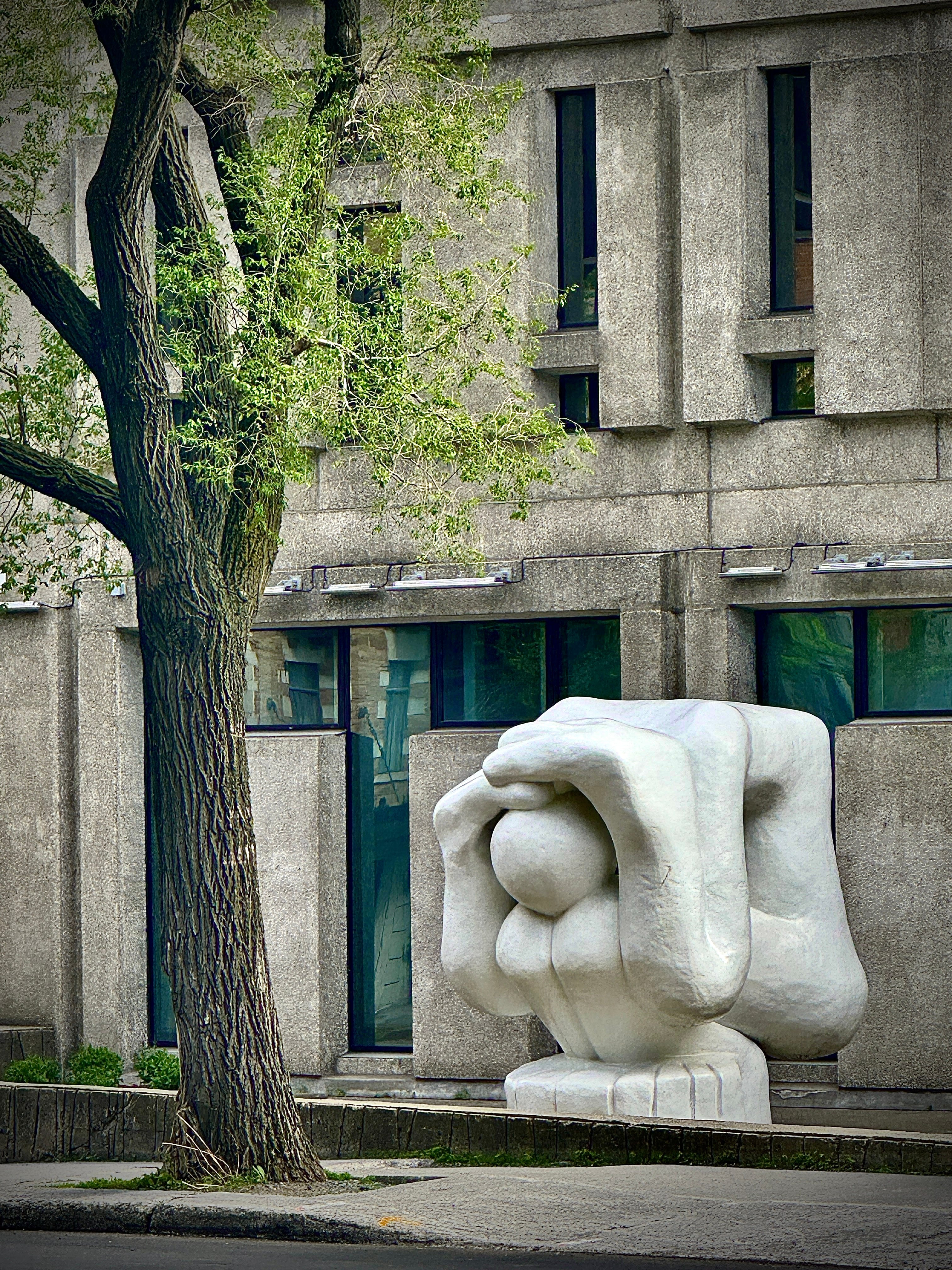
Last week in Montreal’s Quartier latin, I came across a figure I can’t seem to shake. Le malheureux magnifique by Pierre‑Yves Angers sits folded in on itself at the corner of Sherbrooke and Saint‑Denis, its head on its knees, its hands covering the back of its neck. While the piece is certainly larger than life, it somehow finds a way to make itself seem so much smaller.
After a bit of research I discovered the sculpture has been interpreted in all sorts of ways: as a victim of social exclusion, as an expression of sadness, as someone lost in meditation. Yet Angers’ dedication interestingly turns the focus back onto the viewer, offering: À ceux qui regardent à l’intérieur d’eux‑mêmes et franchissent ainsi les frontières du visible, which translates as, “To those who look inside themselves and thus cross over the borders of the visible.”
Now it’s doubtful Angers was thinking about Kanban boards or OKRs when he wrote that line. But if the sculpture invites each of us to examine what our own “borders of the visible” are, the one I notice immediately presents itself in how we design and discuss our work: what ends up on our Kanbans and dashboards and in our Obeyas, and what remains hidden inside our heads and in our bodies and on our calendars.
From Huddled to Seen
I see a lot of organizations assume this posture. People are curled inward under the crushing weight of invisible work and existential pressure of unrealized aspirations, trying to protect whatever focus and sense of meaning they have left. Everything looks solid from the outside, of course, but inside? Those same heads and bodies and calendars are contorted around constraints no one has named yet, let alone can see.
That’s because in most organizations we don’t put those contortions on our walls. Instead we reserve those spaces for plans: strategy decks, roadmaps, OKRs. But the lived experience of doing the work - the context-switching, the unspoken commitments, the fear of dropping the ball on something vital - all of that is left unspoken and untracked. That’s another “border of the visible” - what’s allowed to show up in our external work systems, and what people are expected to subject their own internal operating systems to.
Visual management can either hide that gap or help close it. Kanban, Obeya, visual management - at their very best - are acts of mercy, moving the burden of holding the system from individual bodies (and nervous systems) onto shared walls, where it can be examined, aligned on, and addressed collaboratively. Instead of decorating the room with abstractions, you line the wall with the real system: customer feedback, data on flow, work that is blocked, trade-offs, risks, and decisions that need to be made.
The point isn’t to make the room pretty, it’s to make the work and its constraints undeniable.
Standing in front of Angers’ huddled figure I see what happens when that kind of room doesn’t exist. People end up stitching together (their version of) the entire system in their heads, embodying its weight and risks in their nervous systems. And no single body should have to carry the burden of that much wall on its own.
From Thinking Alone to Thinking Together
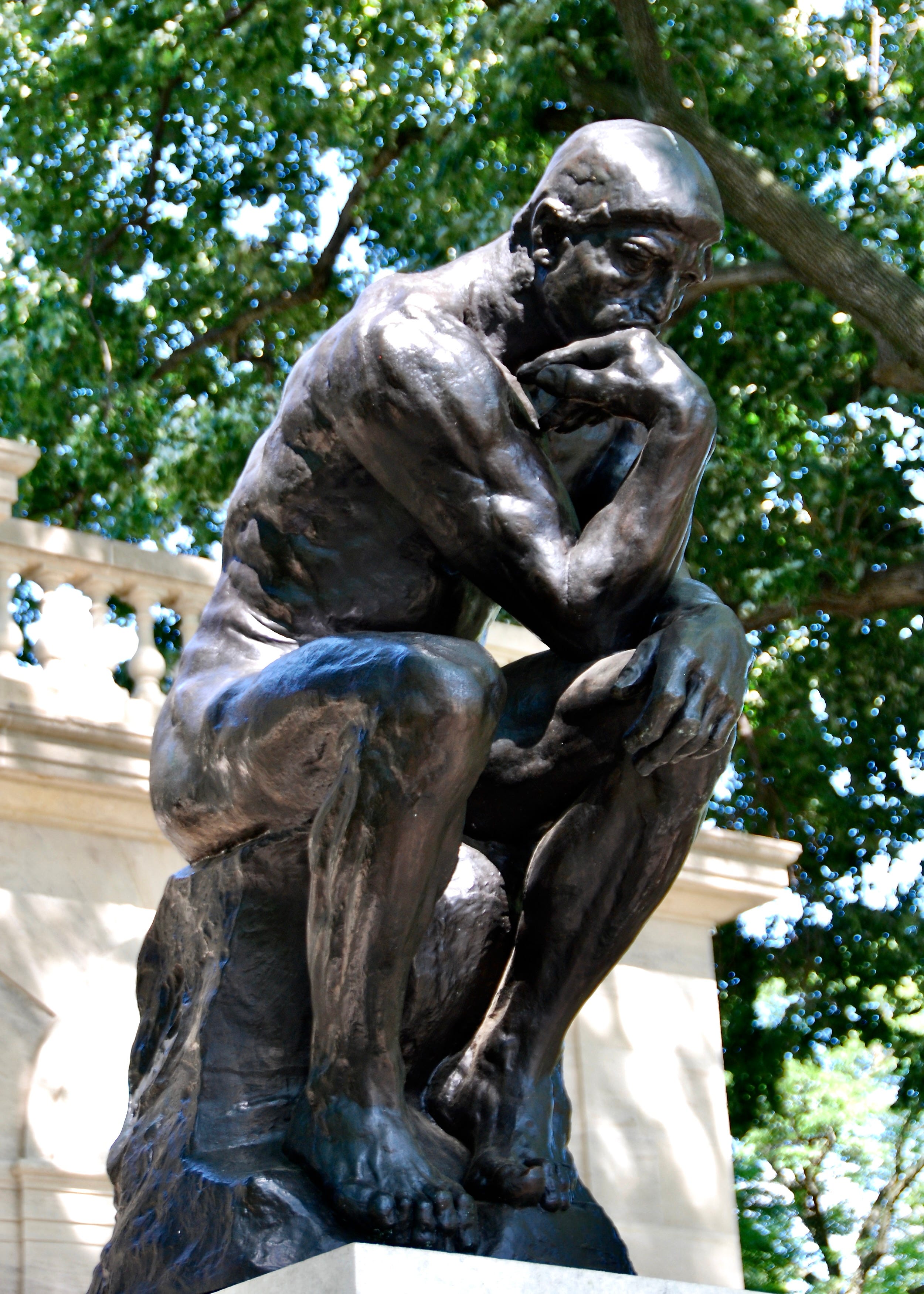
If you head south to Philadelphia, another famous figure has been contemplating things for more than a century now. Rodin’s The Thinker sits along the Ben Franklin Parkway, greeting visitors to the Rodin Museum.
Over the years The Thinker has come to stand for the creative mind at work - a body fully recruited into the act of thinking, not just a head lost in thought. As Rodin put it, the figure thinks “not only with his brain… but with every muscle of his arms, back, and legs, with his clenched fist and gripping toes.”
Where Le malheureux magnifique folds into itself, The Thinker coils forward. One posture is about surviving, the other is about facing.
This is the pivot Jim Benson and I look for when we work with teams. At first, most of the suffering is done in private - people coping individually, creating work‑arounds, carrying unspoken loads. Then something shifts. The team begins to face reality together. They surface blocked work, conflicting priorities, failure demand. They begin to think with the whole system, not just with isolated individuals.
Lean and Kanban give you language and structure for that kind of thinking. WIP limits, service classes, Obeya walls, A3s - these aren’t bureaucratic window dressing but rather (and when used well) they’re how private contortions become shared, deliberate reflection.
From Reflection to Structural Freedom
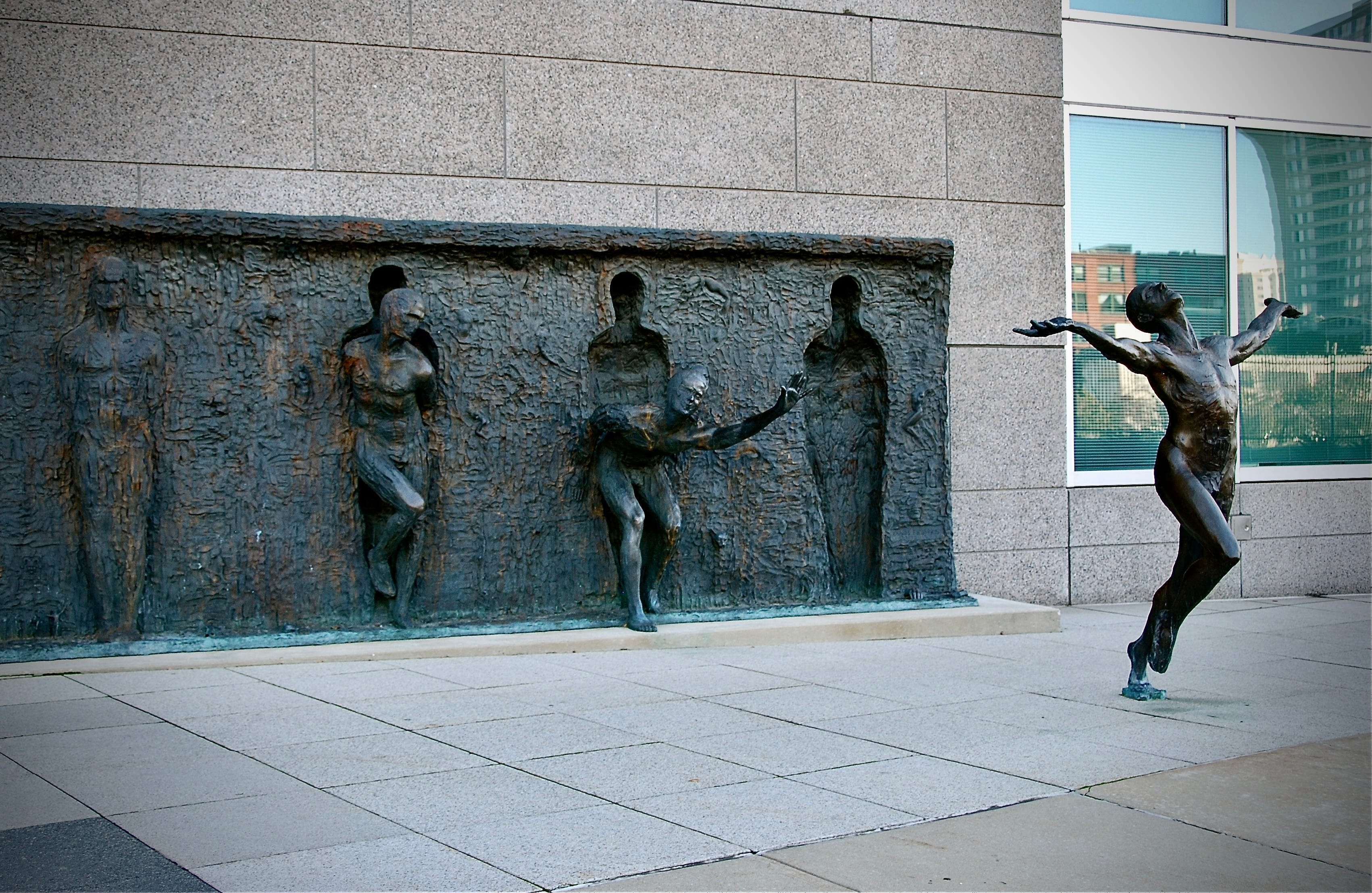
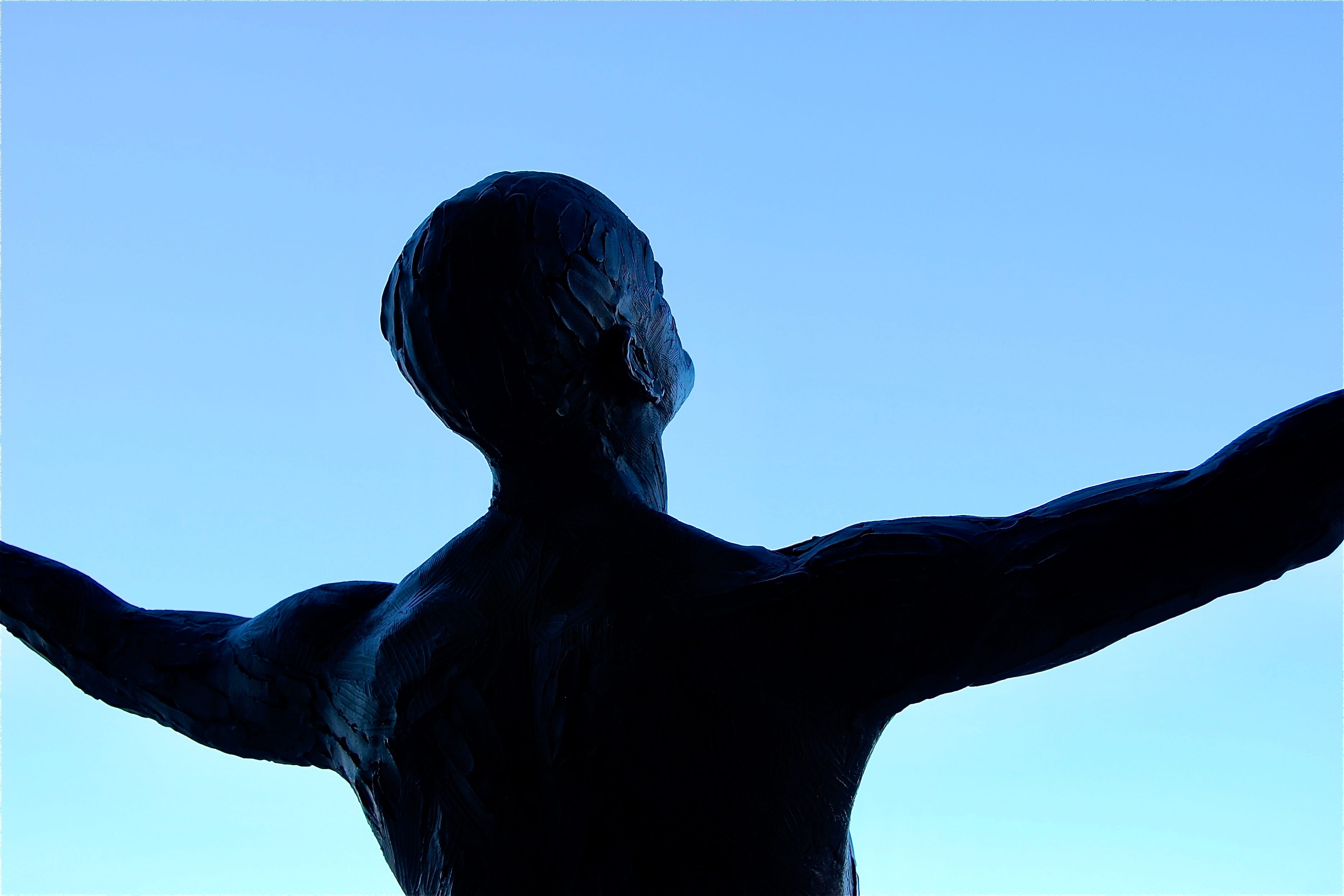
If you stay in Philadelphia and walk over to 16th and Vine outside the GlaxoSmithKline offices, you’ll find an extraordinary piece by my favorite contemporary sculptor Zenos Frudakis. Freedom is a bronze relief in four panels: in the first, a human form is barely emerging from the wall; in the second and third it strains forward. In the last, the figure’s broken free entirely, leaping into space while an empty hollow marks the place it once occupied.
Frudakis is quoted as saying he wanted “a sculpture almost anyone, regardless of their background, could look at and instantly recognize that it is about the idea of struggling to break free.” The work, he notes, is about the struggle for freedom through the creative process and about escaping constraints - internal or external - that hold us back. The piece explicitly invites interaction: there’s a “stand here” space where people can insert themselves into the composition and become part of the narrative. That’s the same invitation I see for leaders and teams: that at some point, you have to stop admiring the wall and decide to step into the work changing it.
If Le malheureux magnifique is the silent, inward‑turned phase, and The Thinker is the phase of shared, deliberate reflection, Freedom is what happens when that reflection actually changes the wall.
In organizational terms, that’s the moment when continuous improvement stops living in workshops and starts living in policy:
When “too much work” becomes a negotiated WIP limit, not a private coping mechanism.
When “we never hear from customers” becomes a visible feedback loop, not a vague complaint.
When “we depend on heroes” becomes redesigned roles and clearer decision rights, not another email thanking the “super heroes and rockstars” who held things together.
The sculpture makes a crucial point: the liberated figure doesn’t simply float away. The wall remembers. The absence is made visible. The structure itself acknowledges that something has changed. That, to me, is the difference between transformation theater and genuine systemic change. And it’s another way of redrawing the borders of the visible so that the system’s real shape finally shows up on the surface.
Where are you in this sequence?
When I look at these three works together, I see a progression that mirrors much of the psychology of work:
A huddled figure in Montreal, carrying everything alone.
A thinker in Philadelphia, fully engaged in making sense of reality.
A freed figure stepping out of the wall that once held them back.
Most teams I meet are somewhere between the first and the second sculpture. People are suffering quietly, or thinking hard, but the wall still looks the same.
The work Jim and I care most about, and the work many of you reading this are probably already doing, is the work of changing the wall so people don’t have to contort themselves into impossible shapes just to contribute in a meaningful way. Kanban, Obeya, and other visual management practices are at their best when they help us do exactly that: change what’s on the wall so we change what’s possible for the people in front of it.
The point of changing the wall is simple yet profound: to stop asking people to make themselves smaller just to fit into a larger-than-life system.
So here’s my question for you, as you look around your own organization:
Do you embody the huddled figure, the thinker, or the wall that’s finally starting to crack?
And if you’re somewhere in between, what would it take - not for individuals to keep contorting themselves, but for the system itself to become more humane?
I know it touches a different aspect of the work, but in case you needed a perfect example of what a humane workplace is not, here's a nice one: https://www.businessinsider.com/jack-dorsey-all-6000-employees-reporting-ceo-middle-managers-2026-4?IR=T