
Down the Dark Corridor
How an art installation illuminated my understanding of Personal Kanban

Last summer I did something completely out of my comfort zone.
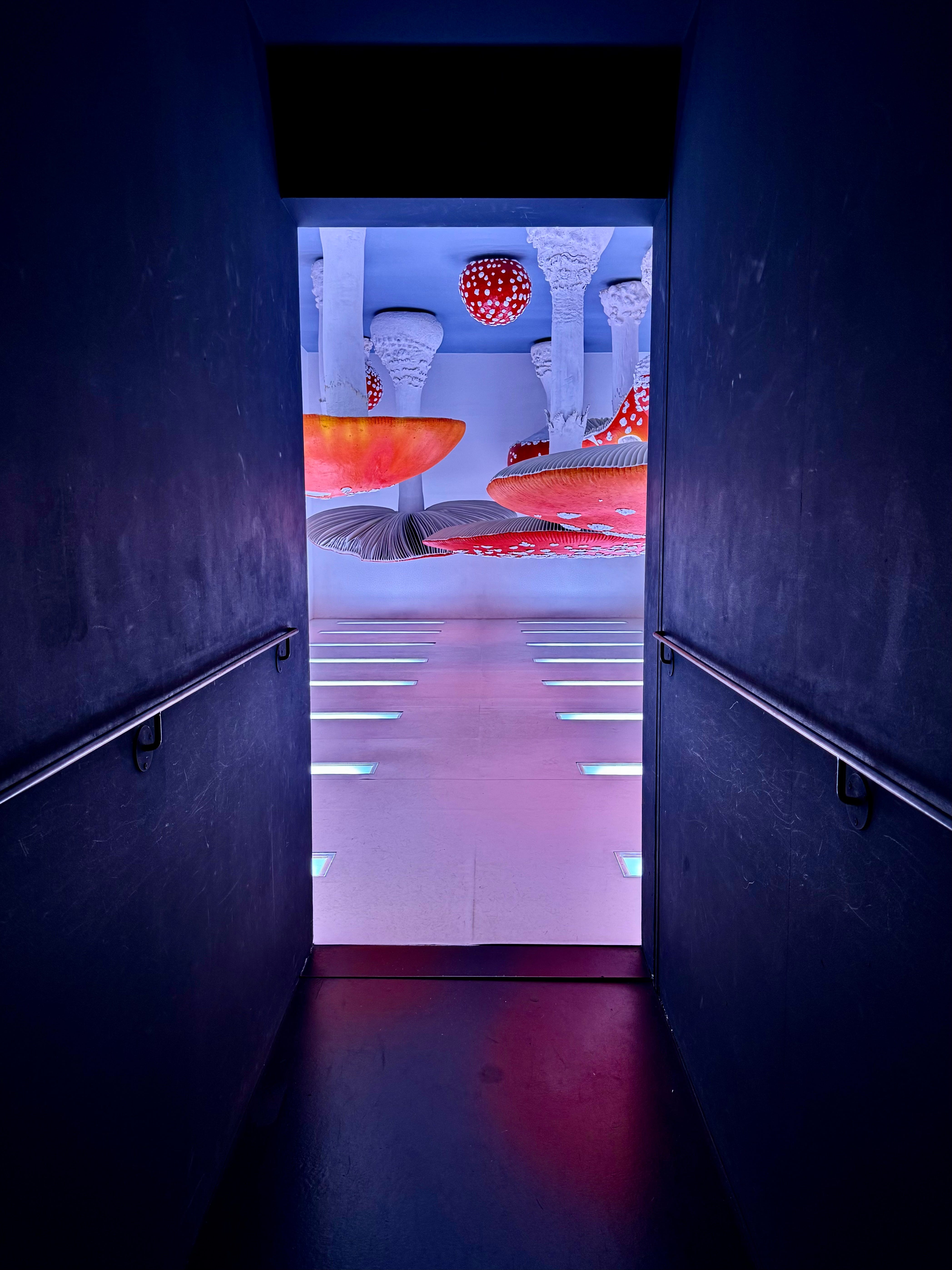
While at Milan’s Fondazione Prada art space, despite warnings to my fellow (intensely) claustrophobic, I engaged in Carsten Höller’s Synchro System installation. An immersive experience that demands an element of trust from the participant, I began my experience tentatively, wending my way through a confined pitch black corridor, guided only by handrailing on the wall. The darkness was soon shattered by violently flashing strobe lights, leading ultimately to an utterly surreal almost hallucinatory surprise upon its conclusion.
Now as someone who needs to feel in control at all times, who builds and analyzes systems for a living, and who teaches people how to visualize and manage their work through such systems, the irony was not lost on me that I was voluntarily surrendering to engineered chaos. In that moment I felt much like Alice tumbling down the rabbit hole into a world where nothing made sense and yet, I too would emerge changed.
When Control Meets Chaos
Within moments of entering that darkened space my body froze in place, rebelling against the lack of clarity, the disorientation. Compounded by intermittent lights, the experience triggered in me something that was almost primal, a desperate need to find stable if not familiar ground, to return to the predictable (inasmuch as anything in Italy can be predictable). I assured myself the space’s founder Miuccia Prada along with her attorneys of course thought through the safety of this exhibition piece, so I mustered up my intestinal fortitude and continued to make my way through the labyrinthine route, my only reference point remaining the railing on the wall that I was now white knuckling, ostensibly guiding me towards something.
Revelations in the Dark
To be sure, a host of personal revelations surfaced from that experience. I discovered my need for control might just be more of a crutch than a strength, and that sometimes the most profound growth comes from surrendering to uncertainty. That simple handrail became a metaphor for the minimal structure I needed to move forward. It wasn’t a roadmap, that’s for sure. But it nevertheless gave me just enough predictability - just enough guidance - to take the next step. Little did I realize how this lesson in letting go would later mirror my relationship with my own productivity system.
And then - almost a year to the day - the realization hit me: that experience exposed the exact same panic I had recently about, of all things, my Personal Kanban.
The Personal Kanban Parallel
I wrote about this a few weeks back, about responding to the overwhelm of my recent relocation to Quebec by closing some of the column containers in my Personal Kanban board, intentionally creating “blinders” to prevent the overwhelm of all I was facing. My article explains why from a neuroscience standpoint this works perfectly fine in that particular context.
But in retrospect, considering it from yet another angle, Höller’s installation suggests why that “blindness” could potentially kill my ability to move forward and appreciate what awaits on the other side when I finally dared to see.
The Mushroom Room: Chaos Transformed
Upon my emergence from the disorienting corridor, I found myself in Holler’s infamous Upside Down Mushroom Room, an utterly surreal space where giant red and white spotted mushrooms were suspended - and twirling - from the ceiling. The room itself seemed to rotate, challenging every assumption about what should be up or down, fixed or fluid. At that point my initial panic transformed into a kind of euphoric disbelief - a child-like wonderment, even - because there in front of me was chaos transformed into something meaningful and joyful, disorientation reframed as revelation. It was creating a new system of flow that intentionally broke my status-quo rules of it.
And full disclosure: the experience proved so transformative that I immediately retraced my steps back to the guard and asked if I could walk through the installation a second time.
Certamente, he offered with a knowing smile. Clearly he’d seen this response…this transformation before.
This is precisely what an effective Personal Kanban does, taking the overwhelming chaos of our work and transforming it into something we can navigate, even when the navigation initially feels uncomfortable. Like those suspended spinning mushrooms that forced me to question my basic assumptions about orientation, a well-designed Personal Kanban board challenges our comfortable illusions about how we work. The initial discomfort of seeing everything laid bare gives way to a new kind of clarity.
It lets you build new kinds of flow that fit what is there, not what you were expecting.
The Neuroscience of Why We Hide From Reality
Standing in that corridor fighting every instinct to do an about face and flee, I realize this physical response perfectly mirrors what neuroscience tells us about status quo bias. Much like Alice’s journey from her comfortable Victorian certainties into a world where she had to question everything she thought she knew, our brains resist the unfamiliar even when the resistance keeps us trapped.
In service of our survival our brains optimize to minimize threat, and so we perceive any change as a threat, even when staying put is unsatisfying, unhealthy, or even dangerous. “The devil you know…” and all that. In organizations, this bias can compound into a collective blindness: we don’t see the work piling up, the bottlenecks forming, the opportunities dissolving because acknowledging them would mean confronting the uncomfortable truth that our current system isn't working.
The real insidiousness of status quo bias lies in how it compounds invisibly. Without visual cues our brains literally cannot manage the accumulation of work in process, the true costs of context-switching, or the patterns of waste we create daily. When work remains abstract - whether it’s living in our heads, hidden in our inboxes, or scattered across tools - we lose the ability to make rational decisions about it. We become like visitors to Höller’s installation, stumbling through the dark, overwhelmed by the stimuli we can't quite grasp, wanting to default to whatever feels safest even if it keeps us trapped.
Visual Management as a Perceptual Reset
So I’ve been thinking a lot about how Personal Kanban becomes kind of a perceptional reset. By making work visible, it forces the same confrontation with reality that Höller’s installation creates but with a crucial difference: where art distorts to make a point, the board distorts to create reality. When you see every task, every blockage, every pattern surfacing on your board, your brain can no longer maintain the comfortable fiction that everything is fine. The cognitive biases that kept you stuck become impossible to sustain against such visual evidence.
Just as I had to place my trust in that handrailing to guide me through the darkness towards this strange revelation, we likewise have to trust the structure of our Personal Kanban to lead us through the temporary discomfort of visibility towards a more honest and effective way of working.
The mushroom room wasn't an end point, but a new beginning, a space where disorientation becomes insight. Similarly, your Personal Kanban doesn't just organize the work in your comfort zone, it can show you what reality has in store and allow you to shift how you perceive and engage with it.
Beyond the Looking Glass: The Courage to See, The Will to Act
After 17 years of teaching, coaching, and delving deep into Personal Kanban, I’ve learned the tool alone is not enough. For me, the lesson of both Höller’s installation and Personal Kanban is this: It’s not enough to make work visible. Visibility is merely the beginning. True transformations - whether personal, professional, organizational - comes when we use that clarity to challenge assumptions, dismantle bottlenecks, and reimagine how we flow through complexity. Like the mushrooms suspended in their surreal dance, our systems are never static. They twist, they twirl, and they evolve in response to the world around them. The question is not whether we face disorientation, but whether we will allow it to guide us towards discovery. As leaders, practitioners, and individuals, the greatest act of mastery is not control, as I once thought. It’s flow. And in that flow lies the potential to redefine how we work, create, and ultimately grow.
Because sometimes, like Alice, the only way to grow is to brave the unfamiliar and see where it leads.
Image and video ©Tonianne DeMaria
Announcing our latest class series: Personal Kanban Evolved!
In the near 2 decades since we introduced Personal Kanban, every conversation, every implementation, and every adaptation has taught us something new. What began at Seattle coffeeshops, DC client sites, and organizations around the globe has evolved into a rich tapestry of insights and revelations we never could have predicted.
Now we’re sharing these deeper layers of comprehension in Personal Kanban Evolved, a series of 4 transformative workshops in August that reveal hidden patterns, advanced techniques, and breakthrough insights we’ve gathered. This isn’t about creating basic boards, its about understanding the deeper psychological, social, and systemic patterns that will make you and your team’s Personal Kanban practice truly transformative. So join us on this journey beyond the basics. Space is intimate and limited so register now.
I've been thinking a lot about "productive struggle," that point where cognitive dissonance and controlled stress can actually enhance learning and adaptation to a new stimuli or context or concept, much in the way we see creative tension on teams drive the need for kaizen.
An analogy: my first (honest) Kanban board. Finally seeing my work in Backlog / Options was akin to that darkened corridor in my post below: both triggered a threat response. In each case, my perception of reality was terrifying to the point of being frozen. And cognitive dissonance resulted because I *thought* I had all my work under control, but alas...
Then my natural inclination was to either hide those items...or abandon my Kanban altogether, because as my favorite early Kanban community saying goes,
"I didn't have these problems before Kanban."
To which the response of course is, "No, you DIDN'T KNOW you had these problems before you started visualizing them with Kanban!" 😉
But much in the way I had that simple handrail guided me through the darkness of that art installation in Milan, my Kanban gave me the minimum viable structure *not* to do / solve everything at once but rather, take the next possible step, act on feedback from that move, then continue. PDSA in action. (Prada-Do-Study-Adjust?)
The real magic happens when I emerged from the darkness and find myself in that admittedly absurd but wholly delightful "Mushroom Room." In Kanban, that "room" is where I see the same tasks repeatedly showing up, the true costs of multitasking, what part of my workflow seems to welcome bottlenecks etc.
So do we solve for discomfort in our systems? Are they bugs...or features? I'd argue so long as we have clarity over their cause and the agency to address them, they're the latter, and the only way we will ever grow beyond our current mental models.
Much appreciation to Tony DeCaria, whose comment in my post inspired my thinking. 🙏🏼